From Blank Page to Living World: The DM's Blueprint for Unforgettable Campaign Settings
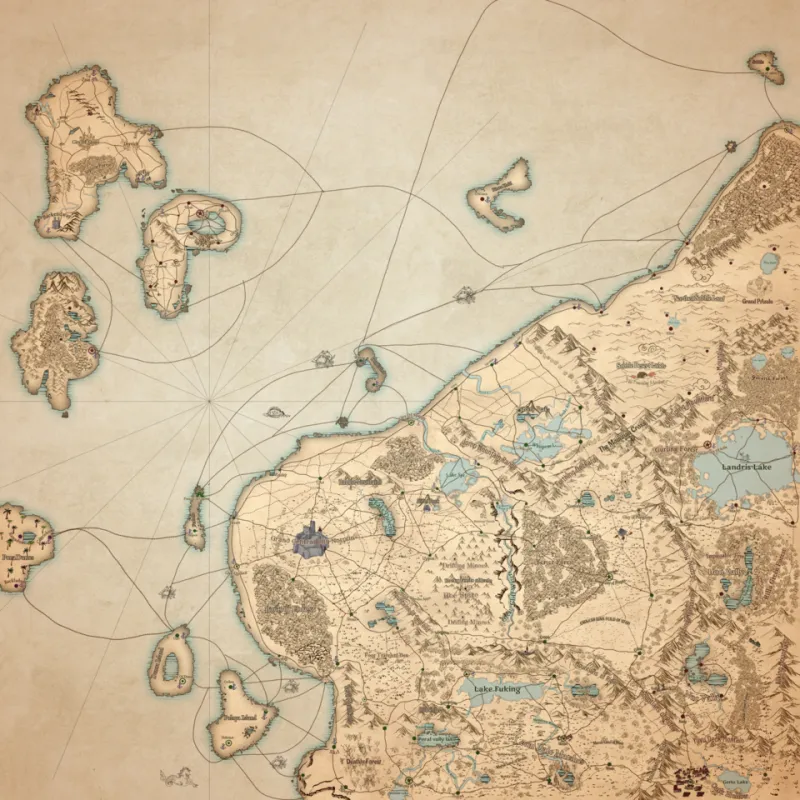
Photo: TheRye69, CC BY-SA 4.0, via Wikimedia Commons
There's a moment every dungeon master knows — you've got a cool idea, maybe a ruined city buried under a frozen tundra or a merchant empire powered by bound demons, and then reality hits: how do you build an entire world around that? It's equal parts exciting and terrifying. The good news? You don't have to wing it. The best worldbuilders in the tabletop RPG community — from Matt Mercer's Exandria to the homebrew legends posting on forums like this one — lean on repeatable frameworks that keep their settings coherent, immersive, and endlessly playable.
Let's break down the real methodology behind great campaign worlds, so you can stop staring at a blank notebook and start forging something legendary.
Start with the Heartbeat, Not the Map
Here's a mistake almost every new DM makes: they draw the map first. Mountains here, ocean there, mysterious forest in the corner — and then they try to figure out what the world means. Flip that process. Before you touch geography, ask yourself one question: What is the central tension of this world?
In Critical Role's Wildemount, that tension is the cold war between the Dwendalian Empire and the Kryn Dynasty, with ancient cosmic horror lurking underneath everything. In Eberron, it's the aftermath of a magical world war and what "rebuilding" looks like when everyone has different agendas. Your world needs a heartbeat — a defining conflict or question that colors everything else.
Once you have that, your geography, factions, and history naturally organize themselves around it. The frozen tundra exists because a civilization burned itself out in magical warfare. The merchant empire uses bound demons because a god of commerce struck a deal three centuries ago and nobody's figured out how to undo it. Everything connects.
The Three-Layer Magic System Rule
Magic systems are where a lot of homebrew worlds fall apart. Either magic is so vague it feels meaningless, or it's so rigidly defined that it kills narrative surprise. The sweet spot is what experienced worldbuilders call the three-layer approach:
- The Source — Where does magic come from? Is it drawn from ley lines, harvested from emotions, spoken into existence by a dying pantheon? This layer gives magic its flavor.
- The Cost — What does using magic take from the world or the caster? Tolkien's ring-wraiths exist because power always demands payment. Brandon Sanderson built an entire career on this principle. Establish consequences.
- The Ceiling — What can magic not do? Limits create drama. If a powerful enough wizard can simply resurrect anyone at any time, death loses all weight at your table.
You don't need to publish a 40-page document on your magic system. You just need clear answers to those three questions, and your world's magic will feel grounded and consistent.
Political Structures That Actually Make Sense
Nothing kills immersion faster than a kingdom that has no logical reason to exist. When you're sketching out governments and factions, think like a political scientist for five minutes. Ask: Who holds power, and why do the people without power allow it?
Take a classic D&D monarchy. The king rules — but why don't the peasants revolt? Maybe there's a genuine divine mandate that citizens can feel (the king's touch heals minor wounds). Maybe a powerful merchant guild keeps the population fed and thus loyal to stability. Maybe the neighboring nation is scarier than the current ruler. Each of those answers creates hooks, NPCs, and entire storylines.
Factions work the same way. Give every major political player in your world a want, a method, and a secret. A thieves' guild wants economic control, operates through blackmail and bribery, and secretly answers to a lich who founded it two hundred years ago. Now that guild isn't just set dressing — it's a living part of your world that players can engage with on multiple levels.
Making Environments Feel Lived-In
This is where good worldbuilders separate from great ones. A city isn't just a collection of shops and taverns — it's the accumulated result of thousands of individual decisions made by people trying to survive and thrive. When you describe a location, layer in the sensory mundane: the smell of the tannery district, the sound of a particular temple's bells at dawn, the way locals avoid a certain alley because of a murder that happened there fifteen years ago.
Try this exercise: pick a location in your campaign world and write ten things that are true about it that have nothing to do with the main plot. What do kids do for fun there? What's the local slang for outsiders? What's a food that locals eat that visitors find disgusting? You'll never use all ten details, but the two or three that naturally slip into your descriptions will make players feel like they've stepped into a real place.
The "Newspaper Test" for World Coherence
Before you run your first session in a new setting, apply the newspaper test: imagine a newspaper from your world's capital city. What are the headlines? What are the advertisements? What scandals are on the gossip page?
If you can't answer those questions, your world might not be fully cooked yet. This isn't about writing a fake newspaper — it's about checking whether your world has enough internal logic and life that ordinary people in it would have ordinary concerns. A world where every headline is about dungeon raids and dragon sightings is a theme park. A world where people are arguing about trade tariffs and occasionally dealing with dragon sightings is somewhere players can actually live.
Steal Like an Architect, Not Like a Copier
Finally — and this is something the best worldbuilders will tell you freely — draw from everything you love, but transform it. Eberron is noir detective fiction meets high fantasy. Ravenloft is gothic horror wearing a D&D costume. Your favorite campaign might be the American frontier as a post-apocalyptic magic wasteland, or feudal Japan reimagined with space elves.
The goal isn't originality for its own sake. It's synthesis. Take influences from history, mythology, science fiction, video games, and pop culture, then run them through the specific lens of your central tension and your world's unique rules. What comes out the other side will feel fresh even when the ingredients are familiar.
World-building isn't a task you complete before the campaign starts — it's something you do with your players, session by session, as their choices shape the living world you've started together. Drop your frameworks in the comments below. We want to see what you're brewing.